Why Repeating a Colour Can Tie an Outfit Together
Repeating a colour can tie an outfit together without exact matching. Learn where to echo a shade and how to build a useful week of combinations.
The most common mistake with repeating a colour is treating it like a matching set: the same shade must appear twice, in similar amounts, or the outfit has failed. That can make getting dressed feel like a hunt for identical pieces, when a softer echo—a small note of blue in a print beside a blue bag, for instance—can already connect separate garments.
Repeating a colour can tie an outfit together by giving the eye a detail to recognise as it moves across the clothes. Think of it like a refrain in a song: the notes need not be identical each time for you to hear the connection. A week of gentle noticing is enough to discover which echoes feel natural in your own wardrobe.
Begin by noticing colours you already repeat
On the first morning, choose an outfit you like without changing anything. Look at it from a little distance, or take a quick mirror photograph, and notice which colours appear more than once. Include small details: a thread in a checked shirt, a button, a printed flower, a belt, or the lining that shows at a turned cuff.
Do not make a shopping list yet. The point is to see what your eye already connects. You might notice that a warm brown shoe picks up the brown lines in a jacket, or that a muted green scarf has a quiet counterpart in a leaf motif on a skirt.
Write down a few colour words that feel useful, such as rust, ink blue, cream or moss. These are personal descriptions, not technical colour labels. If you have trouble naming a shade, photograph it beside a plain white sheet in daylight; the comparison can help you distinguish a cool grey from a brownish one.
Build your week around one recurring colour
On the second day, select one colour from your notes and look for it across your wardrobe. You are not choosing a uniform colour for the week. You are simply asking whether a familiar shade can appear in different places and roles.
Try one clear appearance and one quieter echo. A navy cardigan might be the main note, while a tiny navy flower on a cream blouse supplies the second. Or a red-brown skirt could connect to the warm stitching on a denim jacket. The relationship matters more than identical dye.
- Day one: Notice colours in an outfit you already enjoy and record the small details you might usually overlook.
- Day two: Pick one colour from your notes and find two garments or accessories that contain it in different ways.
- Day three: Wear the colour in a larger area, then echo it in a small detail such as a shoe, print or piece of jewellery.
- Day four: Try the same colour in different shades, such as pale blue with deep navy, and see whether the link still reads clearly to you.
- Day five: Repeat the colour through texture rather than matching tone: a smooth leather belt beside a nubby knit, for example.
- Day six: Leave the colour out of one outfit and notice whether you miss the connection or prefer the cleaner separation.
- Day seven: Keep the combinations that felt easy to wear, and note which colour placements you would use again.
Keep the routine flexible. If a planned piece is in the wash or the weather changes what you want to wear, use another item with a similar colour presence. The exercise is about seeing relationships, not completing a prescribed outfit.
Let shade, texture and scale do some of the work
Exact matches are only one way to repeat a colour. Two shades can feel related because they share a warm or cool quality, or because one looks like a lighter version of the other. A pale sage shirt and a deeper olive bag may read as a family even though their tones differ.
Texture changes how a colour appears, too. A glossy burgundy shoe can look richer than a burgundy wool jumper, but the shared hue still offers a link. In a patterned garment, the repeated colour may occupy only a small part of the surface. That can be enough, especially if the other appearance is also restrained.
Consider how much space each appearance takes up. If a colour already covers a large area, a small echo elsewhere often feels sufficient. If it appears only as a fine line in a print, a more visible accessory may help make the connection easier to notice. There is no fixed proportion to follow; use the mirror to judge whether the echo feels present without taking over.
Why does a colour repeat sometimes feel awkward?
Do the shades have to match exactly?
No. A shared colour family can connect shades that differ in depth or intensity. If they seem to clash to your eye, try changing the amount of one shade or placing a neutral garment between them.
Can a colour in a print count as a repeat?
Yes. A small motif, stripe or printed detail can echo a solid garment or accessory. The colour need not dominate the print; it only needs to be visible enough for you to recognise the link.
How many times should one colour appear?
There is no required count. Two appearances can make a clear connection, while several may suit a more layered outfit; judge by whether the overall combination still feels comfortable and distinctly yours.
What if I only own one item in that colour?
Look for a colour already present in its print, trim or hardware, then echo that through another item. If no natural echo is available, wear the piece on its own rather than buying something solely to complete a pairing.
Use a simple outfit to test the idea
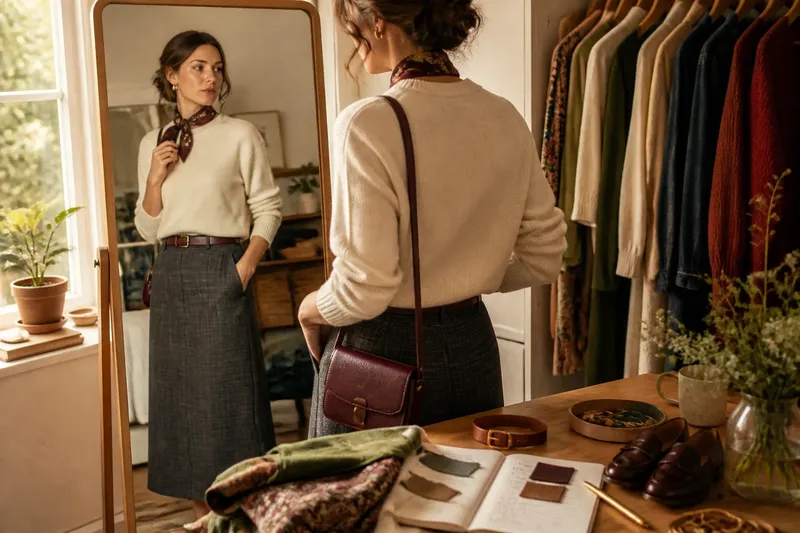
Say you have a charcoal skirt with a tiny burgundy check, a cream jumper and dark shoes. You put on a burgundy scarf, but it feels more prominent than you want. Swap it for a small burgundy hair clip or a bag with a burgundy strap; the expected result is a quieter connection between the check and the accessory, while the cream jumper remains the main contrast.
This kind of adjustment is useful because it changes one element at a time. You can see whether the issue was the colour itself, the amount of it, or where it sat in the outfit. If the smaller echo still feels distracting, leave it out. Repetition is an option for arranging what you own, not a rule that every outfit must obey.
Keep the combinations that feel like you
At the end of the week, look back at your notes or photographs and identify the pairings you would happily wear again. Perhaps a colour works best when it appears in a print and a shoe, or perhaps you enjoy it more as two different shades in soft fabrics. Record those preferences in plain language, such as “olive works with cream” or “red looks better as a small detail”.
Next time you get dressed, repeating a colour can tie an outfit together without demanding a perfect match or a new purchase. Start with a shade already in your clothes, echo it where it feels useful, and stop when the outfit looks settled to you. The best repeat is often the one you notice only after everything else feels right.