The Long Line and the Short Layer: Seeing Proportion
See how garment lengths divide an outfit and use those visual breaks to choose layers that feel balanced, intentional and true to your style.
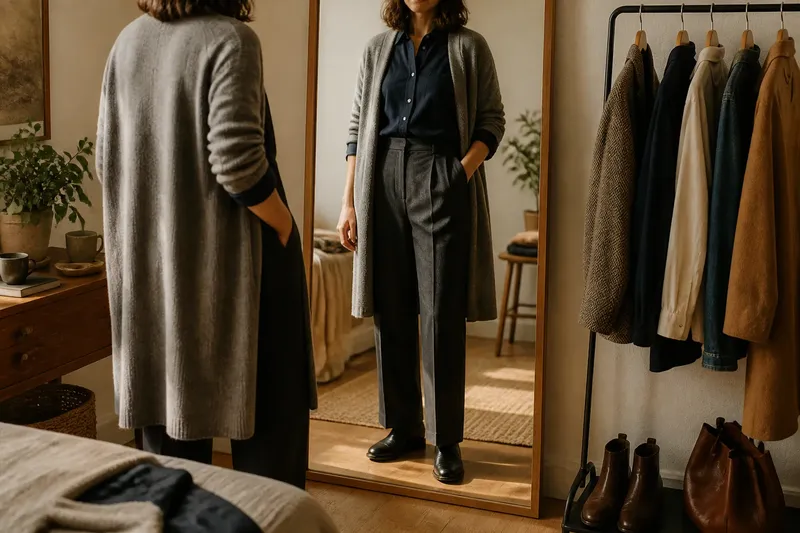
The most common proportion mistake is judging a jacket, top or skirt on its own, then discovering that its hem cuts across an awkward point once the whole outfit is on. That visual division can make a carefully chosen outfit feel less settled than it did on the hanger. To see proportion, look at where each garment ends in relation to the others, not just at the individual pieces.
Think of an outfit as a page divided by pencil lines: each hem creates a new boundary, and the spaces between boundaries affect how the whole looks. There is no single correct division. The useful question is whether the lines feel deliberate, and whether they support the impression you want.
Start by spotting every hemline
Put on the outfit you want to assess, including the shoes you expect to wear. Stand where you can see yourself from head to toe, using a full-length mirror if available. Notice the bottom edge of your top, jacket, cardigan, skirt or trousers; each one can create a horizontal break.
Do not try to correct anything yet. First notice where the breaks fall: at the waist, across the hip, near the knee, or close to the ankle. The same piece can create a different visual division when worn open, tucked in, folded back or layered over another hem.
- Look at the outfit from the front, then turn to the side.
- Notice which hem catches your eye first and whether another hem sits close beside it.
- Check whether a layer finishes at a point you meant to emphasise, such as the waistband or the narrowest part of a skirt.
- Observe the space between the visible hems, rather than estimating your body proportions.
This is observation, not a verdict about your shape. A hem can create a crisp division, a soft transition or a busy cluster of lines. Any of those effects can suit the clothes and mood you have in mind.
Choose the line you want the outfit to lead with
Decide which garment should read as the main line. A long coat worn open can make two continuous vertical edges, while a short jacket can make the waist area the obvious centre. A long shirt over straight trousers creates a different effect from the same shirt tucked in: the first gives the eye a longer uninterrupted panel, and the second exposes the waistband and divides the outfit more clearly.
Ask what you want to notice first. If you like the silhouette of a long cardigan, let it remain visible rather than covering it with a shorter layer that creates a competing break. If you want the waist or a high-rise waistband to show, a cropped knit or a neatly tucked top can make that boundary intentional.
Imagine you have a navy shirt, charcoal trousers and a soft grey cardigan that ends just below the hip. The cardigan hem falls close to the trouser pocket line, making those two horizontal details crowd together. If you wanted the cardigan to read as one long panel, you might try it open over a smoother-fronted pair of trousers; the expected visible change is that the eye can follow its front edges with fewer interruptions.
Test one length change at a time
Once you have chosen the line to emphasise, change only one thing. Tuck the shirt, undo the cardigan, switch to a shorter jacket or try a different skirt length. Then look again from the same position. A single adjustment makes it easier to see which hem created the effect you noticed.
Useful options include:
- Leave a top untucked. This extends its fabric over the waistband and moves the visible boundary lower.
- Tuck or half-tuck a top. This brings the waistband into view and gives the upper layer a more defined endpoint.
- Wear a jacket open. Its edges can frame the centre rather than forming a solid horizontal block across it.
- Try a different layer length. Compare a short jacket with a hip-length cardigan over the same base outfit.
- Adjust the lower garment. A skirt or trouser length can change where the strongest break falls, even if the top half stays the same.
Make a note of what actually changes in the mirror: perhaps the waistband becomes a focal point, the coat looks more prominent, or two nearby hems stop competing. Do not assume that a longer or shorter line is automatically better. The aim is to see the choice clearly and decide whether it matches your intention.
Check how the outfit moves
A static mirror view is only part of the picture. Walk a few steps, sit down and reach for something nearby. A shirt that looked smooth while standing may ride up; a cardigan that seemed to create one long line may swing open and reveal another layer. Those shifts can be part of the look, or they can make the outfit feel less comfortable to wear.
Notice where fabric gathers and where hems separate as you move. If a top keeps slipping out of a tuck, an untucked version may be easier to live in. If a long open layer catches on a bag or bunches at the elbows, a shorter layer may suit the day better. These are practical choices, not failures of proportion.
Also check the outfit with the footwear you intend to wear. A trouser hem that sits neatly over a flat shoe may break differently with a boot, and a skirt can appear to end at a different visual point when the shoe has a contrasting shape or colour. Look at the entire outline before deciding that a hem needs changing.
How do different layer lengths change an outfit?
Does a cropped jacket always make an outfit look shorter?
A cropped jacket creates a clear break near the waist, but what the eye notices next depends on the other lines. A high-waisted skirt or trousers can make that break feel connected to the lower garment, while a long top underneath may introduce another hem nearby.
Should a cardigan end above or below the hip?
Either can work; compare its endpoint with the waistband, pockets and hem of the top underneath. If those boundaries bunch together visually, try a different length or wear the cardigan open so its vertical edges become more noticeable.
How can I tell whether two hems are competing?
Stand back and see whether your attention keeps jumping between closely placed edges. If the outfit feels crowded at that point, changing one layer’s position or choosing a different hem length can make the separation clearer.
Do I need to follow rules about body shape?
No. Shape-based rules can turn a flexible visual choice into a restriction, and they do not account for your clothes, comfort or taste. Use the mirror to identify the effect you prefer, then keep that choice if it feels like you.
Keep a record of the combinations you prefer
When an outfit feels especially coherent, jot down the useful detail rather than trying to memorise a broad rule. You might note that an open jacket works better over a tucked shirt, or that a long top feels less busy with trousers that have a clean front. A quick mirror photo can also help you compare the same outfit with one layer worn differently.
Keep notes specific to the garments involved. “The short denim jacket sits well over this dress” is more useful than “short jackets always work”. Different fabrics hang differently: a crisp cotton shirt holds its edge, while a soft knit may drape over the waistband and blur the division.
When you want to see clothing proportion more clearly, focus on where the hems fall, which line you want to lead, and how the outfit changes when one length shifts. That gives you a simple way to make layers feel intentional without treating any body or garment length as a problem to solve.